

Table of Contents
- Quick Comparison: 7 Investment Property Loans for First Time Buyers
- How We Evaluated These First Time Investor Mortgage Options
- 1. Lender Luke Powered By The Mortgage Exchange: Best for Personalized Guidance
- 2. Kiavi: Best for Fix-and-Flip Speed
- 3. FHA Loan for Multi-Family Investment: Best for House Hacking
- 4. Conventional 97 Loan: Best for Low Down Payment
- 5. VA Loan: Best for Eligible Veterans
- 6. USDA Loan: Best for Rural Properties
- 7. Portfolio Loans: Best for Unique Financial Situations
- What Documentation Do First-Time Investors Need?
- Frequently Asked Questions
Last Updated: September 28, 2026
Quick Comparison: 7 Investment Property Loans for First Time Buyers
Finding the right financing is the single biggest hurdle for new real estate investors. According to Fannie Mae’s latest housing survey, affordability and down payment requirements remain the top barriers to entry. This guide from Lender Luke Powered By The Mortgage Exchange breaks down the 7 best investment property loans for first time buyers, from low-down-payment government programs to specialized investor products.

Here is the quick verdict:
| Loan Option | Best For | Down Payment | Key Advantage |
|---|---|---|---|
| Lender Luke | Personalized guidance | Varies by program | Custom structuring for complex income |
| Kiavi | Fix-and-flip speed | Varies by project | Fast, tech-driven underwriting |
| FHA Multi-Family | House hacking | Low (3.5% for eligible) | Buy up to 4 units, live in one |
| Conventional 97 | Low down payment | Low (3% for eligible) | Standard underwriting, PMI removable |
| VA Loan | Eligible veterans | Zero down for eligible | No PMI, competitive rates |
| USDA Loan | Rural properties | Zero down for eligible | 100% financing in eligible areas |
| Portfolio Loans | Unique financials | Varies | Flexible, held in-house |
Most first-time investors assume they need a massive down payment. In reality, the right program can cut that significantly. The catch is that owner-occupancy rules often apply.
How We Evaluated These First Time Investor Mortgage Options
We scored each option on four criteria: accessibility for first-time buyers, down payment requirements, flexibility for complex income, and speed to close. We prioritized products that let new investors enter the market without a decade of reserves.
1. Lender Luke Powered By The Mortgage Exchange: Best for Personalized Guidance
Lender Luke is our top pick because it pairs lending technology with a dedicated advisory approach. Instead of a call center, you get direct communication and custom loan structures built around your financial goals.
Pros and Cons
Pros:
- Custom loan structuring for complex income scenarios
- Direct communication with no call centers
- Specialized DSCR programs for investors
- Deep knowledge of the local market
Cons:
- Not a one-size-fits-all, high-volume lender
- Best suited to buyers who want guidance, not a fully automated process
For first-time buyers who feel lost in mortgage jargon, a lender that walks you through each step beats a faceless online portal every time.
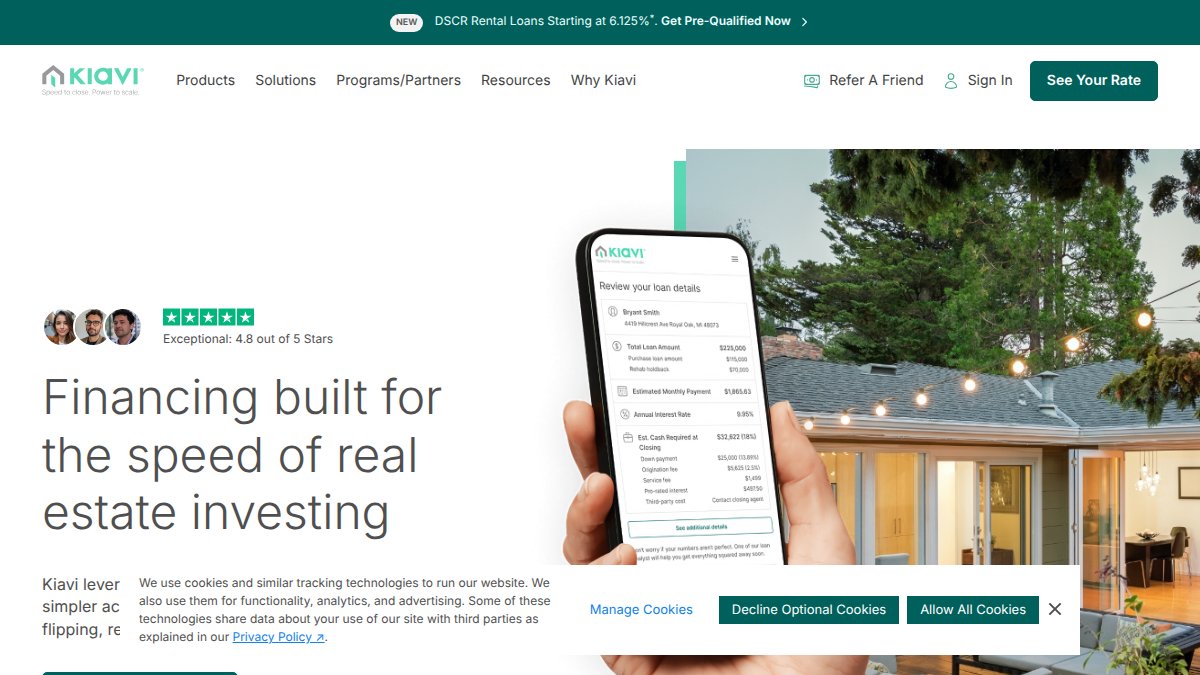
2. Kiavi: Best for Fix-and-Flip Speed
The tradeoff: Kiavi focuses on specific investment property types. If your strategy is buy-and-hold on a standard single-family home, other options may fit better.
Pros and Cons
Cons:
- Focuses primarily on specific investment property types
3. FHA Loan for Multi-Family Investment: Best for House Hacking
An FHA loan for multi-family investment is the classic house-hacking tool, and for a first-time buyer it is often the only path to owning property that produces rental income from day one. The structure is straightforward: buy a property with two to four units, live in one, and rent the others to offset your mortgage. Most top-ranking guides stop there. Here is what they leave out.
How the math actually works
FHA requires a minimum down payment of 3.5% for borrowers with a credit score of 580 or higher (10% is required for scores between 500 and 579). The loan is government-backed through the Federal Housing Administration, which is why the down payment is so low compared to conventional investor loans that typically require 15% to 25% down.
The self-sufficiency rule
For three- and four-unit properties, FHA applies a self-sufficiency test: the property’s total monthly mortgage payment (principal, interest, taxes, and insurance) cannot exceed 100% of the appraiser’s estimated fair market rent for the entire property. Two-unit properties are exempt from this rule. This is the single most common reason a house-hack deal falls apart, and almost none of the competing articles mention it.
What you actually pay for
- Upfront mortgage insurance premium: 1.75% of the base loan amount, financed into the loan.
- Annual mortgage insurance premium: paid monthly, and for FHA loans with less than 10% down it typically lasts the life of the loan.
- Owner-occupancy requirement: you must move in within 60 days of closing and live there for at least 12 months.
Why this matters in North Jersey
Bergen, Hudson, Essex, and Union Counties have some of the deepest two-to-four unit housing stock in the state, from two-family homes in Hackensack and Lyndhurst to three-family properties in Newark, Union City, and Elizabeth. Middlesex County adds towns like New Brunswick and Perth Amboy with similar inventory. For a first-time buyer priced out of a single-family home in these markets, an FHA multi-family purchase is often the difference between renting another year and building equity while a tenant covers most of the mortgage.
Pros and Cons
Pros:
- Down payment as low as 3.5% for qualified borrowers
- Projected rental income from other units can count toward qualifying
- Government-backed, so guidelines are consistent across lenders
- Works with two-, three-, and four-unit properties
Cons:
- Owner-occupancy required for at least 12 months
- Mortgage insurance premiums are mandatory and, with less than 10% down, typically permanent
- Three- and four-unit deals must pass the self-sufficiency test
- FHA loan limits apply and vary by county
Do not buy a multi-family property with an FHA loan intending to rent every unit. Occupancy fraud is a federal offense, and lenders verify residency. If you want a pure rental with no occupancy requirement, look at the DSCR and portfolio options below.
House hacking with an FHA loan is the fastest way for a first-time buyer in North Jersey to convert a rent payment into a mortgage payment. The catch is the self-sufficiency rule on three- and four-unit deals, run those numbers before you make an offer.
::: Mastering these financial requirements remains the most critical of all first-time buyer steps to ensure your transition into property ownership stays sustainable.
4. Conventional 97 Loan: Best for Low Down Payment
The Conventional 97 loan allows eligible first-time buyers to purchase with a low down payment. It offers fixed-rate and adjustable-rate options.
Pros and Cons
Pros:
- Lower down payment than traditional investment loans
Cons:
- Strict debt-to-income ratio requirements
- Requires owner-occupancy
5. VA Loan: Best for Eligible Veterans
A VA loan offers zero down payment for eligible service members and no private mortgage insurance. For veterans looking to buy a primary residence, it is a strong option available.
Pros and Cons
Pros:
- No down payment required for eligible borrowers
- Limits on closing costs
Cons:
Schedule A Free Mortgage Consultation →
- Must be used for a primary residence
- Requires Certificate of Eligibility
6. USDA Loan: Best for Rural Properties
USDA loans provide 100% financing for eligible properties in designated rural and suburban areas. They carry income-based eligibility.
Pros and Cons
Pros:
- No down payment required for eligible buyers
Cons:
- Strict geographic eligibility requirements
- Income limits apply
7. Portfolio Loans: Best for Unique Financial Situations
A portfolio loan is a mortgage the lender keeps on its own books rather than selling to Fannie Mae, Freddie Mac, or another secondary-market buyer. That single fact changes everything about how the loan is underwritten. Because the lender bears the full risk, it can write its own rules, and those rules are often the difference between a denial and a closing for a first-time investor.
How portfolio underwriting differs
Conventional loans sold to the government-sponsored enterprises must follow Fannie and Freddie guidelines: standardized debt-to-income caps, minimum credit scores, reserve requirements, and property-type restrictions. A portfolio lender is not bound by those. In practice, most portfolio lenders still want a reasonable borrower, but the flexibility shows up in specific places:
- Debt-to-income ratio: conventional loans generally cap DTI around 43% to 50% depending on compensating factors. Portfolio lenders may go higher when the file makes sense.
- Credit score: conventional investor loans typically want a 620 minimum, often 680 or higher for the best pricing. Portfolio lenders may work with lower scores in exchange for a larger down payment or higher rate.
- Property condition: non-conforming properties, mixed-use buildings, properties needing renovation, or unique layouts, that fail agency appraisal standards can still qualify.
- Income documentation: self-employed borrowers, commission-heavy earners, and investors with complex tax returns often fit portfolio guidelines better than agency guidelines.
What it costs you
The trade-off for flexibility is price. Portfolio loans typically carry interest rates meaningfully higher than conventional investor loans, and origination fees, points, and prepayment penalties are more common. Down payments often start around 20% to 25% for investment properties, and lenders frequently require six to twelve months of reserves on the subject property.
When a first-time buyer should consider one
Portfolio loans are not the first stop for a new investor. They make sense when:
- You have been denied a conventional loan because of DTI, credit, or property condition.
- You are self-employed and your tax returns understate your real income.
- You are buying a property that does not fit agency guidelines, a mixed-use building, a property with an accessory dwelling unit, or a non-warrantable condo.
- You need a faster or more flexible close than a bank can deliver.
Why this matters in North Jersey
Bergen, Hudson, Essex, Union, and Middlesex Counties have a high concentration of older housing stock, mixed-use buildings, and non-warrantable condos, the exact property types that trip agency guidelines. A portfolio lender who knows these markets can often structure a deal that a national bank would decline outright. If you are a first-time buyer in one of these counties and a conventional loan has already been denied, a portfolio conversation is worth having before you give up on the property.
Pros and Cons
Pros:
- Flexible underwriting for complex income, credit, or property situations
- Can finance property types that fail agency guidelines
- Decisions made locally, often faster than a large bank
- Terms can be tailored to the borrower’s situation
Cons:
- Higher interest rates than conventional investor loans
- Larger down payments and reserve requirements are common
- Prepayment penalties and higher fees are more likely
- Fewer consumer protections than agency loans, read every disclosure
If a conventional lender denies you, ask specifically why. “Does not meet agency guidelines” is a signal to call a portfolio lender, not to stop shopping. The reason for the denial usually tells you which loan type to pursue next.
Portfolio loans are the escape hatch for first-time investors whose finances or target property do not fit the agency box. You pay more in rate and fees, but you close on deals that would otherwise be impossible.
What Documentation Do First-Time Investors Need?
Gather these before you apply to avoid delays:
- Government-issued photo ID
- Last two years of tax returns
- Recent pay stubs or profit-and-loss statements
- Bank statements for asset verification
- Proof of down payment source
- Rental income estimates for the property
Having this ready speeds up underwriting and strengthens your offer. If you want a plain-English walkthrough of how each of these loan types works before you start gathering paperwork, the Free Mortgage Guide covers the basics in one place.
Frequently Asked Questions
Can a first-time homebuyer get an investment property loan?
Yes, but most standard investment property loans require larger down payments and higher credit scores than primary residence loans. First-time buyers often start with owner-occupied options like FHA or Conventional 97, which allow low down payments and can be used for multi-unit properties if you live in one unit. DSCR loans and portfolio loans are also available for investors without prior rental history. Speak with a lender to find the right fit.
What are the down payment requirements for investment property loans?
Down payment requirements vary by loan type. FHA loans for multi-family investment require as little as 3.5% down if you occupy one unit. Conventional 97 loans require 3% down for primary residences. VA loans offer zero down for eligible veterans. USDA loans also offer zero down in eligible rural areas. For pure investment properties, expect 15% to 25% down. DSCR and portfolio loans often require 20% or more. Always confirm current guidelines with your lender.
How does a DSCR loan work for rental properties?
A DSCR loan qualifies you based on the property’s rental income rather than your personal income. The debt service coverage ratio (DSCR) is calculated by dividing the property’s net operating income by its total debt obligations. Most lenders look for a DSCR of at least 1.0 to 1.25. These loans are popular with self-employed borrowers and first-time investors who lack traditional W-2 income. They often close faster than conventional loans because underwriting focuses on the property’s cash flow.
What is the difference between a primary residence loan and an investment loan?
Primary residence loans are for homes you occupy and typically offer lower interest rates, lower down payments, and more flexible credit requirements. Investment property loans are for properties you rent out and usually carry higher rates, larger down payments, and stricter underwriting. Government-backed loans like FHA and VA require owner occupancy, so they are not available for pure investments. If you plan to house hack, you may qualify for primary residence financing while renting out part of the property.
Do I need a higher credit score for an investment property loan?
Yes, investment property loans generally require higher credit scores than primary residence loans. Conventional investment loans often look for a minimum 620 credit score, while DSCR and portfolio loans may accept scores as low as 620 or require 700 or higher depending on the lender. FHA loans for multi-family investment allow scores as low as 500 with 10% down, but most lenders set their own minimums. Check with your lender to understand specific requirements for your situation.
Qualifying for your first investment property does not require a perfect financial profile. It requires the right loan structure and a lender who understands your situation. Lender Luke Powered By The Mortgage Exchange offers personalized loan solutions, custom structuring for complex income, and specialized DSCR programs for investors. Get started with Lender Luke and move from browsing listings to closing on your first rental.

